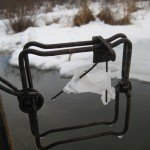
The other day I was watching a Youtube video on muskrat trapping and saw a set I'd never seen before. The young trapper in the video made a baited set with a 110 conibear, but it wasn't bait he used on the trigger - it was a piece of flagging tape. The tape works as a visual attractor and its bright color resembles some sort of food under the water. I found it hard to … [Read more...]
Small Trickles are Great Places to Catch Mink and Muskrats
Narrow areas along small waterways offer a great opportunity to pick up traveling mink and muskrats as they move in search of food and/or shelter. The location below was the outlet of a small culvert, with a trickle of water leading to a canal. There were limited locations to set conibears in the canal, but this waterway allowed the perfect opportunity to put in a 110. I … [Read more...]
Set Wingwalls for Traveling Mink and Muskrats
Concrete wingwalls are common features at road crossings that can help you catch more critters on your trapline. Mink and muskrats are constantly traveling along waterways, and their paths tend to be funneled through bridges and culverts at road crossings. Below is a location where I noticed animals moving along a the concrete wall, and entering/exiting the water right at its … [Read more...]
Skunk in a Culvert
It looked like critters were traveling along this dry wash, and the culvert made a perfect spot for a set. I placed the rock and some other sticks along the sides to funnel down the travel way, and set a 110 conibear with some bait and 'magnum marten' lure. The next day, I was greeted by this guy, a good sized striped skunk. Luckily he had already sprayed and was expired … [Read more...]